
innovation in sensing ............ about / scope / services / IP / Tow Wizard / links, articles etc.

The fluxgate magnetometer is a magnetic field sensor for vector magnetic field. Its normal range is suitable for measuring earth’s field and it is capable of resolving well below one 10,000th of that. It has traditionally been used for navigation and compass work as well as metal detection and prospecting. Not difficult to construct it is often forgotten in today’s world of silicon and MEMS devices.
Fluxgate magnetometer designs fall into broadly two styles, those employing twin rod cores and those using ring cores. Whilst there are many alternative designs, mostly based on rod cores, none have reached the state of development and performance attributed to these two styles. For this reason this page is intended to apply only to the twin rod and ring core fluxgate variants.
All fluxgates use a highly permeable core which serves to
concentrate
the magnetic field to be measured. The core is
magnetically saturated
alternatively in opposing directions along any suitable axis,
normally by means of an excitation coil driven by a sine or square
waveform. Prior to saturation the ambient field is channelled through
the core producing a high flux due to its high permeability. At the
point of saturation the core permeability falls away to that
of
vacuum causing the flux to collapse. During the next half cycle of the
excitation waveform the core recovers from saturation, and the flux due
to the ambient field is once again at a high level until the core
saturates in the opposite direction; the cycle then repeats. Despite
the magnetisation reversals due to the excitation, the flux from the
ambient 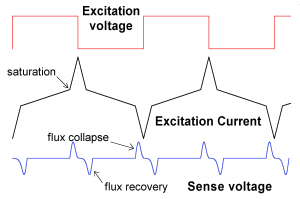 field
operates in the same direction throughout. A sense coil
placed around the core will pick up these flux changes, the sign of the
induced voltage indicating flux collapse or recovery. The name fluxgate
clearly derives from the action of the core gating flux in and out of
the sense coil. This process is shown in the figure on the left as
idealised
waveforms, and it can clearly be seen that the sense voltage is twice
the frequency of the excitation.
field
operates in the same direction throughout. A sense coil
placed around the core will pick up these flux changes, the sign of the
induced voltage indicating flux collapse or recovery. The name fluxgate
clearly derives from the action of the core gating flux in and out of
the sense coil. This process is shown in the figure on the left as
idealised
waveforms, and it can clearly be seen that the sense voltage is twice
the frequency of the excitation.
Demodulation schemes often employ 2nd harmonic detection for this reason. In practice for a single rod shaped core the sense coil will pick up the excitation drive as well as the signal voltage, which due to its high level can prove troublesome to remove electronically. A common solution for this is to use two parallel cores with the excitation phase reversed from one to the other. The sense coil picks up the signal but the induced excitation voltage is cancelled by the phase reversal, producing waveforms similar to those shown here.
 As
described, the voltage of the flux change peaks is from
Faraday’s law proportional to the magnetic field; a simple
sensor
can be used in this way. However a superior design will employ a coil
(the sense coil often doubles up for this task) to feedback a magnetic
field in opposition to the sensed field, such that the two fields cancel
one another. In this mode of operation, where the fluxgate is used as a
null detector, the current in the feedback coil is proportional to the
sensed field.. The technique improves linearity of measurement, allows
a much greater dynamic range to be achieved and is used by the majority
of modern devices.
As
described, the voltage of the flux change peaks is from
Faraday’s law proportional to the magnetic field; a simple
sensor
can be used in this way. However a superior design will employ a coil
(the sense coil often doubles up for this task) to feedback a magnetic
field in opposition to the sensed field, such that the two fields cancel
one another. In this mode of operation, where the fluxgate is used as a
null detector, the current in the feedback coil is proportional to the
sensed field.. The technique improves linearity of measurement, allows
a much greater dynamic range to be achieved and is used by the majority
of modern devices.
Download a more comprehensive article here Fluxgate Explained
- 93kB pdf
Copyright ©KS Evans, March 2006